Home › Sengoku & Azuchi-Momoyama · 1467 – 1590s
The Warring States: When Everyone Wanted to Be Boss
Quick version
- The Ōnin War (1467–77) wrecked Kyoto and the shogun's authority.
- Gekokujō, 'the low overthrow the high', became the era's motto.
- Daimyō ruled their own territories, wrote their own laws and built castle towns.
- Rivals like Takeda Shingen and Uesugi Kenshin fought for years at Kawanakajima.
After the Ōnin War (1467–77) burned much of Kyoto, the Ashikaga shoguns still existed, but nobody was listening to them. Local strongmen took the hint. For more than a century, Japan was a patchwork of rival territories. We call it the Sengoku (戦国) period, “the age of warring states”.
The motto of the age: gekokujō
Gekokujō (下剋上) means “the low overthrow the high”. A deputy could replace his lord, and a farmer’s son could become a general. Saitō Dōsan, “the Viper of Mino”, is said to have risen from oil merchant to ruler of a province. Whether or not every story is true, the point stands: birth mattered less than strength and cunning.
Daimyō and their little countries
The new rulers were the sengoku daimyō. Each ran his domain like a small state:
- House laws (bunkokuhō) set rules for his samurai and farmers.
- Castle towns (jōkamachi) gathered warriors, merchants and craftsmen around one fortress.
- Land was measured and taxed, and roads and mines were developed to feed the army.
Famous names include Takeda Shingen in Kai, Uesugi Kenshin in Echigo, the Hōjō of Odawara, Imagawa Yoshimoto in Suruga and Mōri Motonari in the west.
The great rivalry
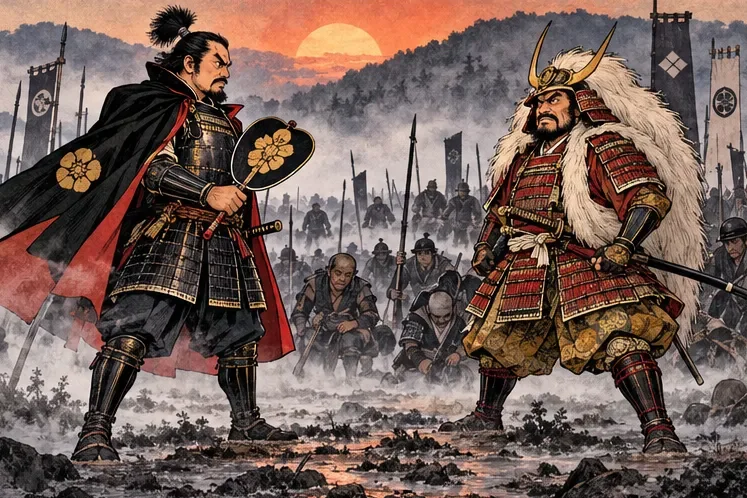
Shingen and Kenshin met at Kawanakajima (in today’s Nagano) five times between 1553 and 1564. Their most famous clash is the tale of Kenshin charging at Shingen, who is said to have blocked the sword with his war fan. Great story, uncertain history, wonderful statue.
See it today
- Takeda Shrine (Kōfu, Yamanashi): built on the site of Shingen’s mansion, with his statue outside the station.
- Odawara Castle (Kanagawa): the Hōjō stronghold, with a reconstructed keep and a good museum.
- Kasugayama Castle ruins (Jōetsu, Niigata): Kenshin’s mountain fortress.
Festival connection
Two spring festivals bring the era to life with armoured parades: Kōfu’s Shingenkō Festival and Yonezawa’s Uesugi Festival. For horse-borne warriors in full armour, see the Sōma Nomaoi in Fukushima (late May; about 400 riders in samurai armour), and for a castle-town spring festival, the Inuyama Festival.