Home › Sengoku & Azuchi-Momoyama · 1543 – 1630s
Guns, Missionaries and Funny-Looking Ships
Quick version
- Portuguese traders reached Tanegashima in 1543 and introduced the matchlock gun.
- Francis Xavier landed at Kagoshima in 1549 and began Christian missions.
- Some daimyō converted, partly for the trade; Nagasaki grew from a small port.
- Hideyoshi banned missionaries in 1587, and 26 Christians were executed in Nagasaki in 1597.
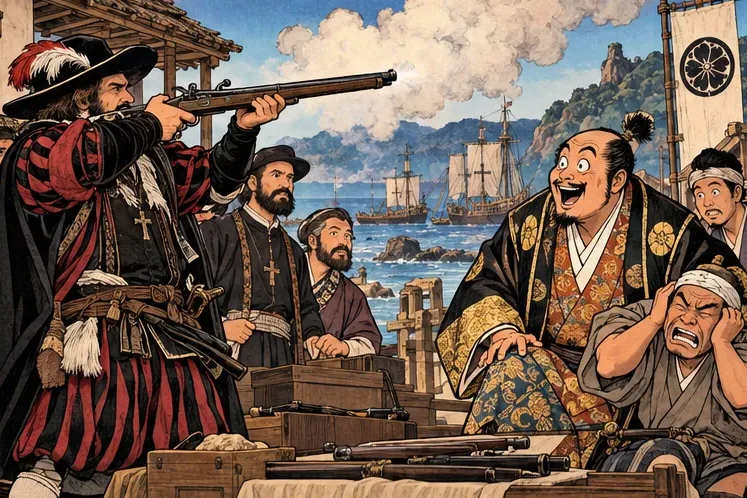
In 1543, a Chinese ship carrying Portuguese traders was blown off course and landed on Tanegashima, a small island south of Kyushu. The local lord was fascinated by their long iron tubes that went bang. He bought two and had his swordsmiths copy them. Within a few years, Japan was producing matchlock guns (tanegashima in Japanese) by the thousand.
Guns change the battlefield
Samurai tradition prized single combat. Muskets did not care about tradition. Lords who could afford gun units, like Oda Nobunaga, gained a decisive edge (see the Nobunaga chapter). Castles got thicker walls and cleverer layouts in response.
Francis Xavier and the Jesuits
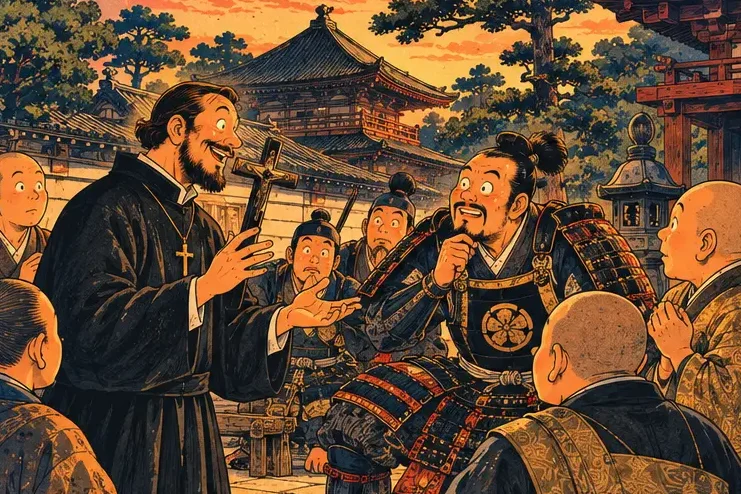
In 1549 the Jesuit missionary Francis Xavier landed at Kagoshima. Over the next decades missionaries spread Christianity, especially in Kyushu. Some daimyō, known as the Kirishitan daimyō, converted. Their motives were mixed: faith for some, trade with the Portuguese for others.
Ōmura Sumitada opened the port of Nagasaki to Portuguese ships in 1571, turning a fishing village into a bustling international harbour. This Nanban trade (the “southern barbarians” trade) brought silk and guns in, and silver out.
From welcome to ban
As Christian communities grew, so did the unease of the rulers. In 1587 Hideyoshi ordered missionaries out. In 1597 he had 26 Christians arrested and crucified at Nagasaki. Persecution deepened under the Tokugawa; the story continues in the chapter on the closed country.
See it today
- Tanegashima (Kagoshima): the island where the guns arrived, reachable by ferry or short flight from Kagoshima.
- Twenty-six Martyrs Memorial and Museum (Nagasaki): a moving visit near Nagasaki Station.
- Hidden Christian Sites in the Nagasaki and Amakusa Region: a UNESCO World Heritage listing of churches and villages where believers practised in secret.
- Ōura Church (Nagasaki): built in 1864 and among Japan’s oldest surviving Western-style churches.
Festival connection
Nagasaki’s Kunchi (October) mixes Japanese, Chinese and Dutch influences in one big parade, and the Lantern Festival (Lunar New Year) lights up the Chinese quarter. Karatsu’s Kunchi in November is another great port-town festival.