Home › Sengoku & Azuchi-Momoyama · 1534 – 1582
Oda Nobunaga: The Warlord Who Broke the Rules
Quick version
- Nobunaga defeated the much larger Imagawa army at Okehazama in 1560.
- He used guns at Nagashino (1575) and built Azuchi Castle on Lake Biwa.
- He ended the Ashikaga shogunate in 1573 and burned the Enryaku-ji temple complex in 1571.
- In 1582 his general Akechi Mitsuhide attacked him at Honnō-ji in Kyoto, and Nobunaga died.
Oda Nobunaga (1534–1582) started as the odd young lord of a small corner of Owari, known for strange clothes and unruly manners. He ended up changing the course of Japanese history.
The underdog win: Okehazama
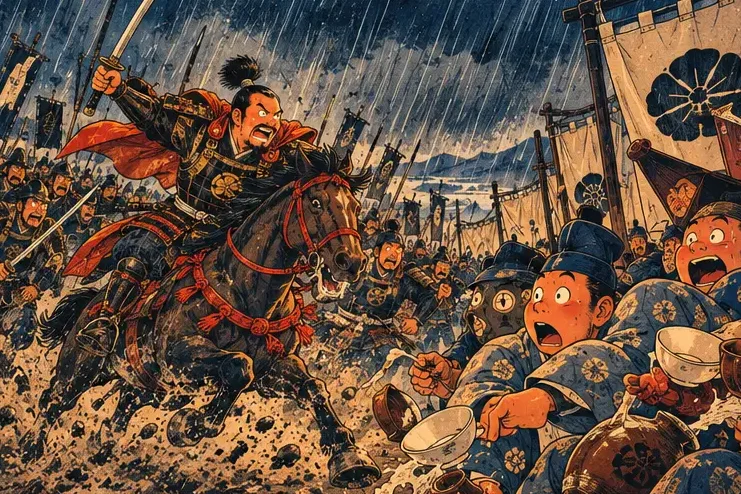
In 1560, Imagawa Yoshimoto marched toward Kyoto with a huge army. Nobunaga, vastly outnumbered, struck during a downpour at Okehazama and killed Yoshimoto. The Imagawa collapsed, and Nobunaga’s name was made.
New tools, new rules
- Guns: at Nagashino (1575) his gunners faced Takeda cavalry. The story of three rotating firing lines is famous, though historians debate the details.
- Free markets (rakuichi-rakuza): he removed guild monopolies and tolls to boost trade.
- Azuchi Castle (1576–79), on Lake Biwa: a tall, showy keep, partly a political message and partly a home.
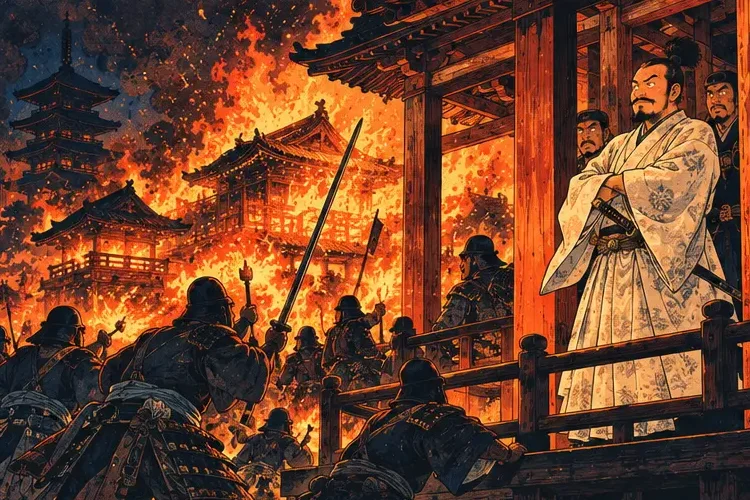
- Ruthlessness: in 1571 he burned the great Enryaku-ji monastery on Mt Hiei, because its warrior monks had backed his enemies. In 1573 he drove out the last Ashikaga shogun.
Honnō-ji, 1582
By 1582 Nobunaga controlled much of central Japan. While staying at Honnō-ji, a temple in Kyoto, he was attacked by his own general Akechi Mitsuhide. Nobunaga died as the temple burned. Nobody is sure why Mitsuhide did it; historians have offered many theories. Mitsuhide lost to Toyotomi Hideyoshi within about two weeks, which is why people call him “the 13-day shogun”.
See it today
- Azuchi Castle ruins (Ōmihachiman, Shiga): climb the great stone stairway; the nearby Nobunaga no Yakata museum displays a full-scale replica of part of the keep.
- Enryaku-ji (Mt Hiei, Kyoto/Shiga): rebuilt after the burning, now a UNESCO site and a serene mountain monastery.
- Honnō-ji (Kyoto): the present temple stands on a different spot than the original, but holds a small museum and Nobunaga’s memorial.
- Gifu Castle (Gifu): a hilltop castle linked to Nobunaga, reached by ropeway.
Festival connection
The Jidai Matsuri in Kyoto (22 October) is a parade of about 2,000 people in costume, running backwards from the Meiji Restoration to the Heian period; look for Nobunaga and Hideyoshi along the way. Gifu also holds a Nobunaga festival in autumn.