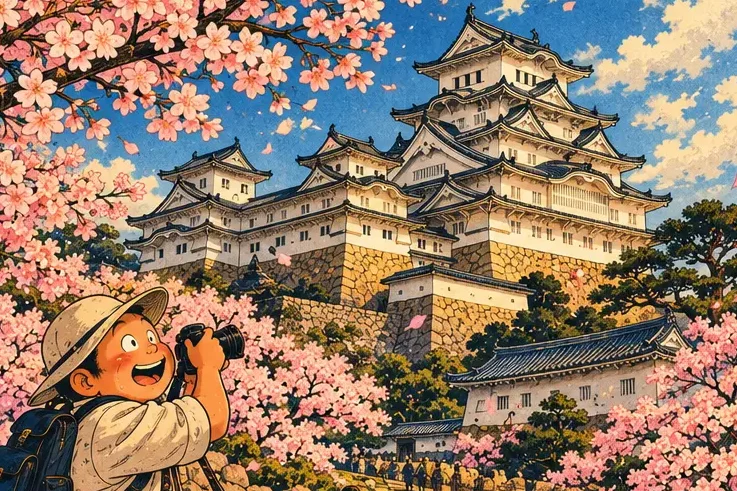
Home › Sengoku & Azuchi-Momoyama · c. 1550 – 1615 (peak)
Castles 101: How to Read a Japanese Castle (and Where to Find the Real Ones)
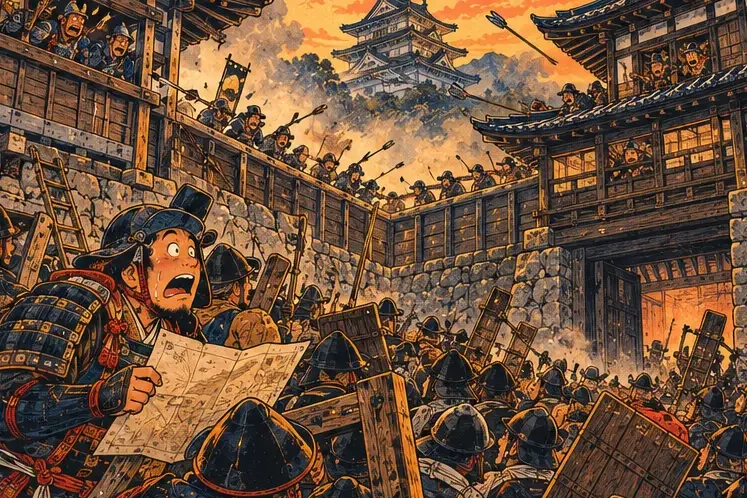
Quick version
- A Japanese castle is a whole fortress compound; the keep (tenshu) is just the tallest building.
- Stone walls, moats, and winding gates were designed to confuse attackers.
- In 1615 each domain was limited to one castle.
- Only twelve original keeps survive; Himeji is the best known.
If you visit Japan, you will see a lot of castles. Knowing a few basics will turn them from “pretty buildings” into a puzzle you can read.
Anatomy of a castle
- Tenshu (keep): the tall tower, part lookout, part status symbol, part last refuge.
- Ishigaki (stone walls): gently curved at the base and steep at the top, built to be hard to climb.
- Moats and gates: gates often open into a masugata, a square courtyard where attackers get trapped and shot at from every side.
- Yagura (turrets) and loopholes: small windows shaped for guns or arrows.
- Honmaru: the innermost compound, where the lord lived.
Why so many castles?
The Sengoku era was the golden age of castle building. Peace changed that. In 1615 the Tokugawa issued the Ikkoku-ichijō rule: one castle per domain. Hundreds of castles were torn down. After 1868 many more were demolished, and wartime bombing destroyed others.
The twelve original keeps
Of the keeps that survive from before 1868, only twelve are original (the rest, however beautiful, are reconstructions):
| Castle | Prefecture | Notes |
|---|---|---|
| Hirosaki | Aomori | Famous for cherry blossoms |
| Matsumoto | Nagano | The “Crow Castle”; National Treasure |
| Maruoka | Fukui | Among the oldest |
| Inuyama | Aichi | Overlooks the Kiso River; National Treasure |
| Hikone | Shiga | National Treasure |
| Himeji | Hyōgo | UNESCO World Heritage; National Treasure |
| Matsue | Shimane | National Treasure |
| Bitchū-Matsuyama | Okayama | Highest-altitude surviving keep |
| Marugame | Kagawa | Famous stone walls |
| Matsuyama | Ehime | Hilltop castle with ropeway |
| Uwajima | Ehime | Compact and elegant |
| Kōchi | Kōchi | The whole compound survives |
Five of these (Matsumoto, Inuyama, Hikone, Himeji, Matsue) are National Treasures. Famous castles like Osaka, Nagoya and Kumamoto are reconstructions, and still worth a visit. Kumamoto Castle was badly damaged in the 2016 earthquake and its restoration has been ongoing.
Planning a castle trip
- Easy day trip: Himeji by Shinkansen from Osaka or Kyoto, about an hour.
- Alps and castles: Matsumoto, with views of the Japanese Alps on a clear day.
- Coast and calm: Matsue, with its lake sunsets and old samurai streets.
Check opening hours and any renovation closures before you go; inside, shoes come off and stairs can be steep.
Festival connection
Castles host some of the best seasonal events. The Hirosaki Castle Snow Lantern Festival (February) and the Inuyama Festival (April) both unfold in the shadow of an original keep. More at Japan Festival Atlas.