The Tokugawa System: How to Run a Country for 260 Years
Quick version
- The shogun ruled from Edo; around 260 daimyō governed their own domains (the bakuhan system).
- Sankin-kōtai required daimyō to spend alternate years in Edo and leave their families there.
- Society was officially divided into samurai, farmers, artisans and merchants.
- Edo grew into one of the world's largest cities, with around a million people.
In 1603 Tokugawa Ieyasu became shogun and set up his government in Edo, a modest castle town that is now Tokyo. His family would stay in power for about 260 years. How?
Shogun and domains
Japan under the Tokugawa is called the bakuhan system: bakufu (the shogunate) plus han (domains). The shogun directly controlled key cities, mines and ports. Roughly 260 daimyō governed their own domains, but under strict supervision.
Daimyō were sorted by loyalty. Fudai daimyō had served the Tokugawa before Sekigahara and held posts in government. Tozama (“outer”) lords had been rivals and were kept far from Edo and out of power.
Sankin-kōtai: the expensive commute
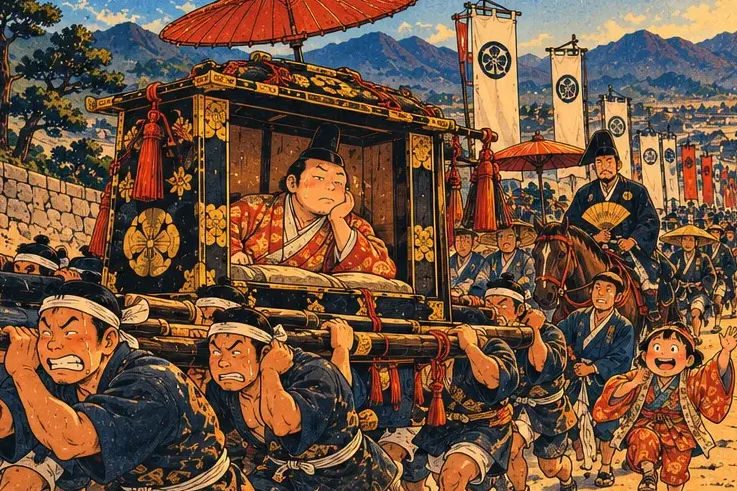
Under the sankin-kōtai system (formalised in 1635), daimyō had to spend alternate years in Edo, and leave their families there permanently as quasi-hostages. Processions of hundreds, even thousands, of retainers travelled the roads each year. The effect was huge:
- Daimyō were kept too poor to plot rebellions.
- Roads, inns and post towns boomed.
- Edo, packed with samurai households, became a giant consumer city.
Four classes
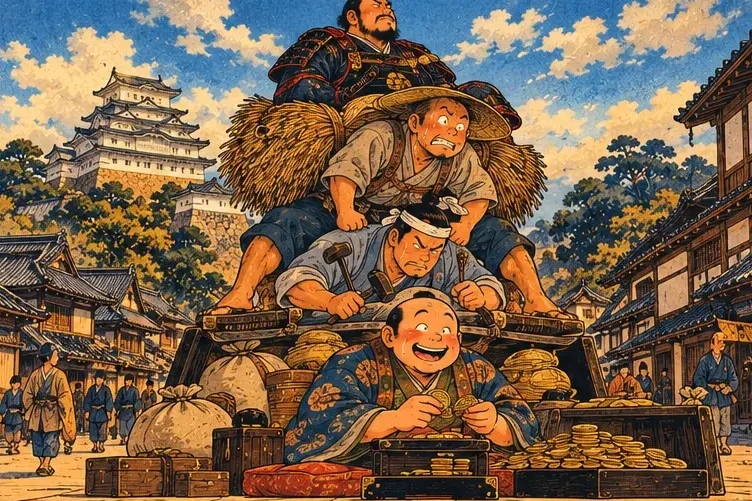
Society was officially divided into shi-nō-kō-shō: samurai, farmers, artisans and merchants. In practice, merchants grew rich while many samurai grew poor, paid in rice they had to sell to merchants. The tension helps explain Edo’s great culture and the later fall of the system.
Edo, the giant
By the 1700s Edo had around a million inhabitants, among the largest cities in the world. Osaka was the “kitchen of Japan”, where rice was traded, and Kyoto remained the home of the emperor and of traditional crafts.
See it today
- Imperial Palace East Gardens (Tokyo): the site of Edo Castle. Stone walls and gates survive.
- Edo-Tokyo Museum (Ryōgoku, Tokyo): the main museum on Edo life. Check its current opening status before visiting.
- Edo-Tokyo Open-Air Architectural Museum (Koganei, Tokyo): real historic buildings relocated to a park.
Festival connection
Tokyo’s great festivals, Kanda Matsuri and Sanja Matsuri, are rooted in Edo-period townsfolk culture. Hakone’s Daimyō Gyōretsu recreates a sankin-kōtai procession.