Home › Muromachi · 1333 – 1392
Two Courts, One Country: The Ashikaga Take Over

Quick version
- Emperor Go-Daigo overthrew the Kamakura bakufu in 1333 with help from Ashikaga Takauji and Kusunoki Masashige.
- Go-Daigo's Kenmu Restoration (1333–36) angered warriors by favouring courtiers.
- Takauji installed another emperor in Kyoto and became shogun; Go-Daigo fled to Yoshino.
- The Northern and Southern Courts coexisted until 1392.
By the early 1300s the Kamakura bakufu was weak, wounded by the cost of the Mongol invasions and by quarrels among its own samurai. Emperor Go-Daigo saw his chance. Exiled to the Oki Islands for plotting, he escaped in 1333 and rallied supporters. A Kamakura general, Ashikaga Takauji, switched sides and captured Kyoto. Others took Kamakura itself. The Hōjō regime ended in 1333.
The Kenmu Restoration
Go-Daigo tried to rule directly, like the emperors of old. He favoured nobles and ignored the warriors who had fought for him. Takauji, disappointed, rebelled in 1335. In 1336 he put a different emperor on the throne in Kyoto and issued a legal code. In 1338 he took the title shogun, starting the Ashikaga shogunate, also called the Muromachi bakufu after the Kyoto district where its headquarters stood.
Two courts
Go-Daigo escaped to Yoshino, in the mountains south of Nara, and declared that he was the real emperor. For almost sixty years (1336–92), Japan had a Northern Court in Kyoto (supported by the Ashikaga) and a Southern Court in Yoshino. Local lords picked sides to suit their interests. The third shogun, Ashikaga Yoshimitsu, finally persuaded the Southern emperor to return to Kyoto in 1392.
A loyal hero
Kusunoki Masashige fought for Go-Daigo and died at the Battle of Minatogawa in 1336. Later centuries celebrated him as a model of loyalty.
See it today
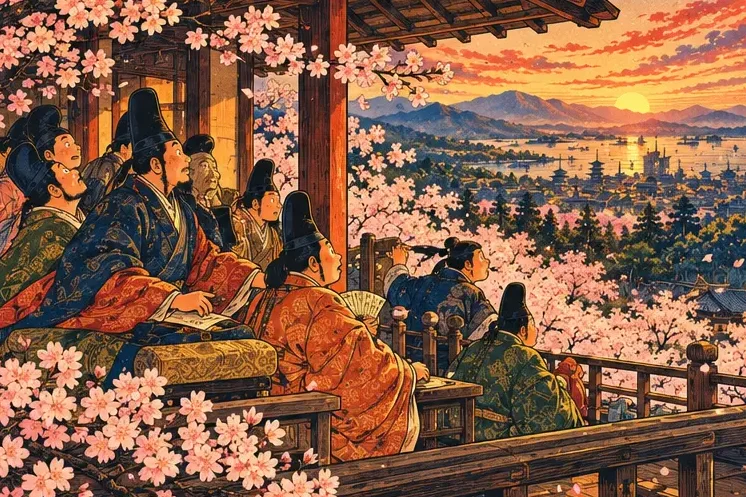
- Yoshino (Nara): the mountain of cherry trees (thousands of them), with the temple Kinpusen-ji and the Southern Court’s remains. Part of a UNESCO World Heritage listing. Cherry blossoms usually peak in April.
- Minatogawa Shrine (Kōbe): dedicated to Kusunoki Masashige.
- Chihaya-Akasaka (Osaka): the area of Masashige’s hilltop fortress.
Festival connection
Find shrine and temple events near Nara and Kyoto on Japan Festival Atlas.