The 'Closed Country' That Wasn't Really Closed
Quick version
- A series of edicts (1630s) restricted foreign trade and banned Christianity.
- The Shimabara Rebellion (1637–38) hardened the policy.
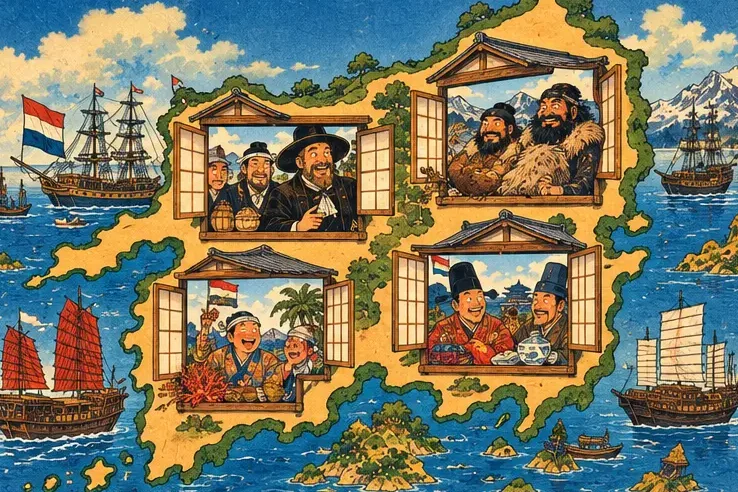
- Trade continued via four 'windows': Nagasaki, Tsushima, Satsuma and Matsumae.
- Dutch traders at Dejima brought 'Dutch Learning' (rangaku), a source of Western science.
You may have heard that Japan was “closed” for over 200 years. The reality is more interesting. The word sakoku (鎖国, “closed country”) was coined in the early 1800s. The policy itself was about control, not isolation.
Why close the doors?
The Tokugawa feared two things: foreign powers that might ally with rebellious lords, and Christianity, which preached loyalty to a higher power than the shogun. In the 1630s a series of edicts limited Japanese travel abroad and foreign access to Japan.
The turning point was the Shimabara Rebellion (1637–38), a large uprising of farmers and masterless samurai, many of them Christian, in Kyushu. It was crushed with great force at Hara Castle. In 1639 the Portuguese were expelled.
Four windows
Contact with the world continued, but under careful control:
| Window | Partner | Managed by |
|---|---|---|
| Nagasaki | Dutch and Chinese traders | The shogunate |
| Tsushima | Korea | The Sō clan |
| Satsuma | The Ryūkyū Kingdom (Okinawa) | The Shimazu clan |
| Matsumae | The Ainu (Hokkaidō) | The Matsumae clan |
Dejima
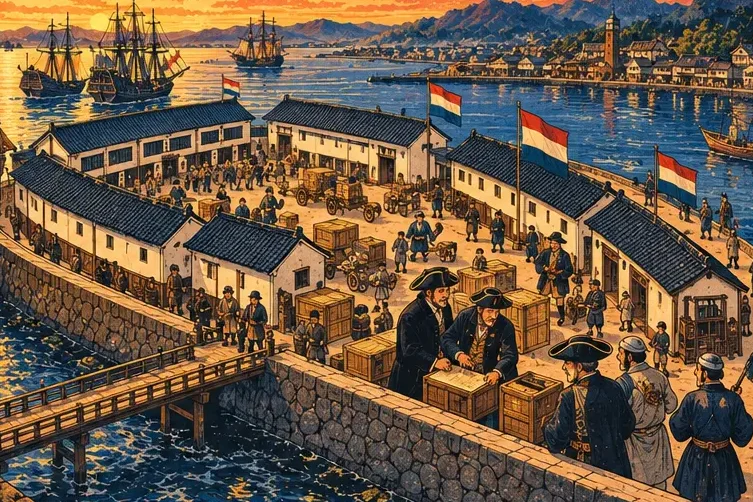
The Dutch were allowed to trade only on Dejima, a small fan-shaped artificial island in Nagasaki Bay, from 1641. They brought books, instruments and news. Japanese scholars studied them under the name rangaku, “Dutch learning”, especially medicine and astronomy. The German doctor Philipp von Siebold taught there in the 1820s.
The end of the policy
In 1853 American Commodore Perry arrived demanding trade, and sakoku cracked (see the Bakumatsu chapter).
See it today
- Dejima (Nagasaki): partly restored, with period buildings and museum displays. The island is no longer an island, as the surrounding bay has been filled in.
- Hara Castle ruins (Minamishimabara, Nagasaki): the last stand of the rebels.
- Hidden Christian Sites (Nagasaki and Amakusa): UNESCO World Heritage.
- Nagasaki’s Chinese quarter and Glover Garden: later chapters of the city’s international story.
Festival connection
Nagasaki’s Lantern Festival (around Lunar New Year) and Kunchi (October) reflect the city’s Chinese and Dutch heritage.