Home › Postwar to Reiwa · 1955 – 1991
The Economic Miracle: Bullet Trains, Olympics and the Bubble
Quick version
- From the mid-1950s to 1973 the economy grew at roughly 10% a year.
- The 1964 Tokyo Olympics and the opening of the Tōkaidō Shinkansen showed the new Japan to the world.
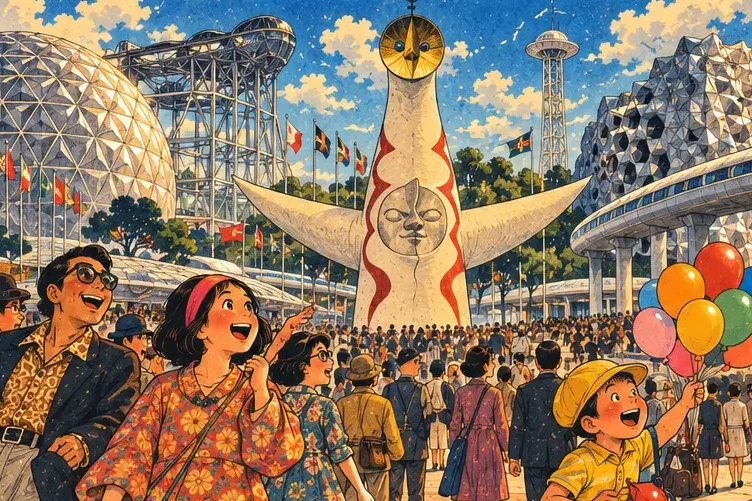
- Osaka hosted the 1970 World Expo; the Tower of the Sun still stands.
- A property and stock bubble in the late 1980s burst around 1991.
By 1950, Japan was recovering from the war. The Korean War brought orders for supplies, and from the mid-1950s the economy took off. A government report in 1956 declared that “the postwar period is over”. Growth averaged about 10% a year until the oil shock of 1973.
Why so fast?
Hard-working people, close cooperation between government and business (especially the Ministry of International Trade and Industry), a high savings rate, cheap technology and open access to the American market all played a part. Companies such as Toyota, Sony and Honda became world names. Many households aimed to own the “three sacred treasures”: a TV, a washing machine and a refrigerator.
1964: the world watches
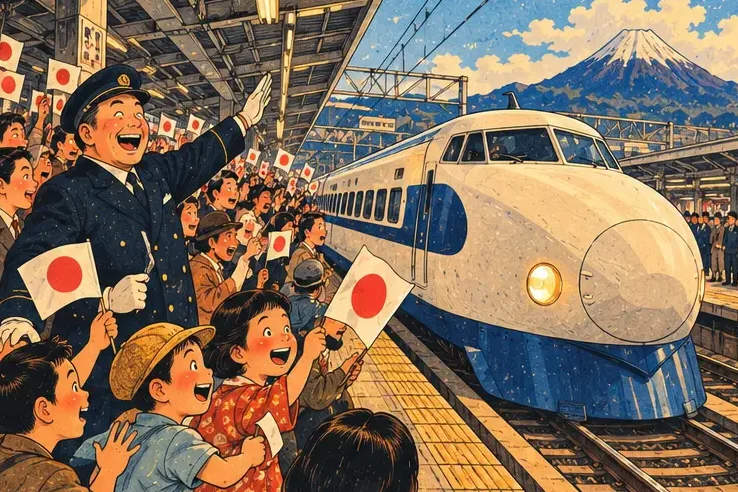
Tokyo hosted the Olympics in October 1964, the first in Asia. Days before the opening, on 1 October 1964, the Tōkaidō Shinkansen began running between Tokyo and Osaka, cutting travel time to about four hours at first. It was the world’s first high-speed rail line.
Expo ’70
The 1970 World Exposition in Osaka drew about 64 million visits. Artist Okamoto Tarō’s Tower of the Sun became its symbol.
Bubble and bust
After the 1985 Plaza Accord raised the value of the yen, cheap credit pushed up property and share prices. At the peak, the grounds of the Imperial Palace were said to be worth more than all of California. The bubble burst around 1990–91, leading to years of slow growth, often called the “lost decades”.
See it today
- Expo ’70 Commemorative Park (Suita, Osaka): the Tower of the Sun, which you can enter on a tour, and the Expo ’70 Pavilion.
- Yoyogi National Gymnasium (Tokyo): Tange Kenzō’s 1964 Olympic swimming arena.
- Railway Museum (Saitama) and SC Maglev and Railway Park (Nagoya): Shinkansen history.
- Ride the Shinkansen itself: still one of the best ways to see the country.
Festival connection
Osaka’s summer boat festival, the Tenjin Matsuri, predates all this by about a thousand years, and is a nice counterpoint to the modern city.