The Kofun Period: Giant Keyhole Tombs and the Yamato Court
Quick version
- Kofun are earthen burial mounds; the keyhole shape is uniquely Japanese.
- The Daisen Kofun (Osaka) is among the largest tombs in the world by area.
- The Yamato court united powerful clans under a ruler who became the 'great king' (ōkimi).
- Immigrants from the mainland brought writing, new technology and horses.
Kofun (古墳) simply means “old tomb”, and these tombs are the reason the period is named as it is. Between roughly 250 and 538 CE, powerful rulers across Japan were buried in huge earthen mounds.
The keyhole shape
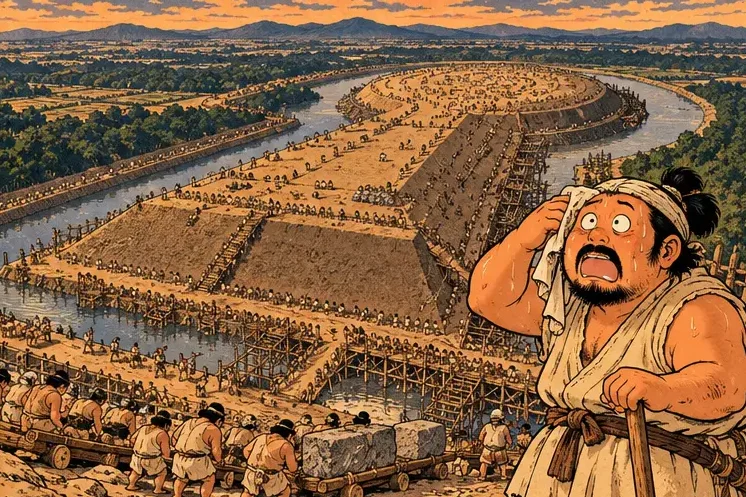
The classic Japanese tomb is the zenpō-kōen-fun, a “keyhole” shape: a round back joined to a square front, often surrounded by a moat. The biggest is the Daisen Kofun near Osaka, traditionally linked to Emperor Nintoku, over 480 metres long. It is part of the Mozu-Furuichi Kofun Group, a UNESCO World Heritage Site.
Haniwa: the clay entourage
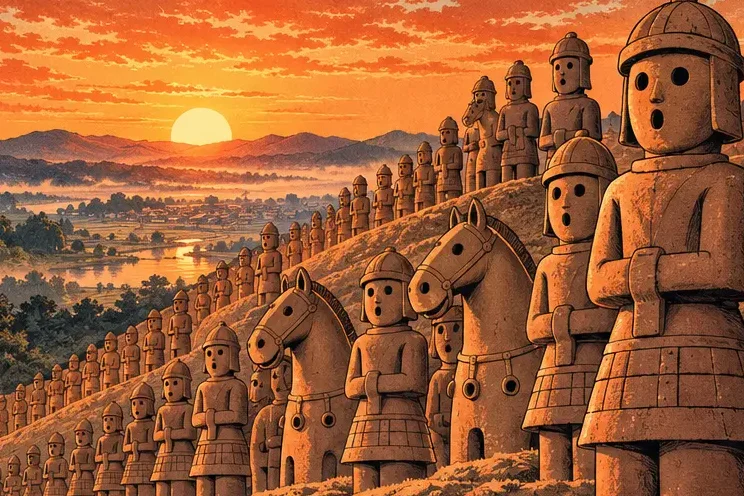
Mounds were lined with haniwa, hollow clay cylinders and figures of houses, horses, warriors and dancers. They guarded the dead, marked the sacred space, and give us a wonderfully detailed picture of how people dressed and lived.
The Yamato court
Tomb size shows political power. The largest cluster is in the Kinai region (around modern Nara and Osaka), where the Yamato court emerged. Its leader, the ōkimi, claimed authority over regional clans by granting them ranks and titles (uji and kabane). This is the root of the imperial line.
Newcomers and new tools
Groups of immigrants (toraijin) brought iron-working, horse breeding, weaving, and the Chinese writing system. Japan would take Chinese characters and later adapt them for its own language.
See it today
- Daisen Kofun (Sakai, Osaka): you cannot walk on the tomb, but the Sakai City Hall observation deck gives a view over it.
- Mozu-Furuichi Kofun Group (Osaka): dozens of tombs you can stroll around, a UNESCO World Heritage Site.
- Asuka Village (Nara): giant stone monuments and small tombs, easily explored by rental bike.