Home › Asuka & Nara · 538 – 794
Asuka & Nara: Buddhism, Laws and a Great Buddha
Quick version
- Buddhism arrived in 538 (or 552, depending on the source) and caused a clan feud.
- Prince Shōtoku set up the Twelve-Level Cap Ranks and the Seventeen-Article Constitution.
- The Taika Reform (645) aimed to put land and people under the court's control.
- Heijō-kyō (Nara) became the capital in 710; the Great Buddha was finished in 752.
By the 500s the Yamato rulers were strong, but their neighbours China and Korea had written laws, big cities and a new religion. Japan decided to catch up.
Buddhism causes a family feud
Buddhism officially arrived from the Korean kingdom of Baekje in the mid-500s. The Soga clan wanted to adopt it; the Mononobe and Nakatomi clans preferred the traditional kami. The Soga won and rose to power.
Prince Shōtoku
Prince Shōtoku (574–622), regent for Empress Suiko, is the star of this era. He:
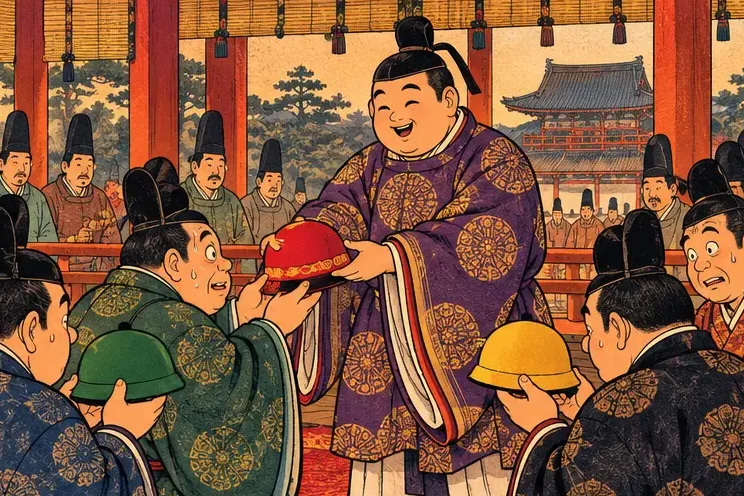
- created the Twelve-Level Cap and Rank System (603), promoting people by ability rather than birth alone;
- issued the Seventeen-Article Constitution (604), a set of moral rules for officials, starting with “harmony is to be valued”;
- sent envoys (kenzuishi) to Sui China;
- built Hōryū-ji, among the world’s oldest wooden buildings.
The Taika Reform and the ritsuryō state
In 645, Nakano Ōe (later Emperor Tenji) and Nakatomi no Kamatari overthrew the Soga and launched the Taika Reform: land and people would belong to the state, with taxes in rice (so), local goods (chō) and labour (yō). In 701 the Taihō Code gave Japan its ritsuryō system of penal and administrative law.
Nara: the first real capital
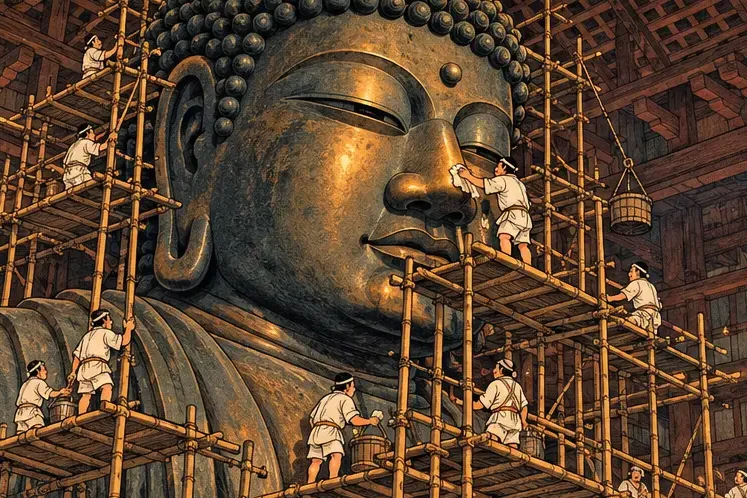
Earlier rulers moved house with every reign. In 710 the court settled in Heijō-kyō (Nara), modelled on China’s Chang’an. Emperor Shōmu, hoping to calm disasters and plague, had the giant bronze Buddha of Tōdai-ji completed in 752. Poetry collection Man’yōshū and the histories Kojiki and Nihon Shoki date from this era too.
See it today
- Hōryū-ji (Ikaruga, Nara): the wooden temple complex founded by Prince Shōtoku.
- Tōdai-ji (Nara City): home of the Great Buddha Hall, with the famous deer of Nara Park outside.
- Heijō Palace Site (Nara City): the reconstructed vermilion gate of the old capital.
Festival connection
Every March, Tōdai-ji holds Omizutori (the Shuni-e), a fire-and-water ritual at Nigatsu-dō hall that has run, almost unbroken, since the year the Great Buddha was dedicated (752). Nara also has the Wakakusa Yamayaki hillside burning in January and the Kasuga Matsuri in March.