A Constitution and Two Wars: Japan Joins the Great Powers
Quick version
- The Meiji Constitution was issued in 1889; the first Diet met in 1890.
- Japan won the First Sino-Japanese War (1894–95) and gained Taiwan.
- Japan won the Russo-Japanese War (1904–05), a first for an Asian power against a European one.
- In 1910 Japan annexed Korea, a legacy that still shapes relations today.
By the 1880s the Meiji leaders wanted a constitution, in part to show Westerners that Japan was a modern state. Itō Hirobumi studied European systems and chose the Prussian model: a strong executive, with the emperor holding great authority.
The Meiji Constitution
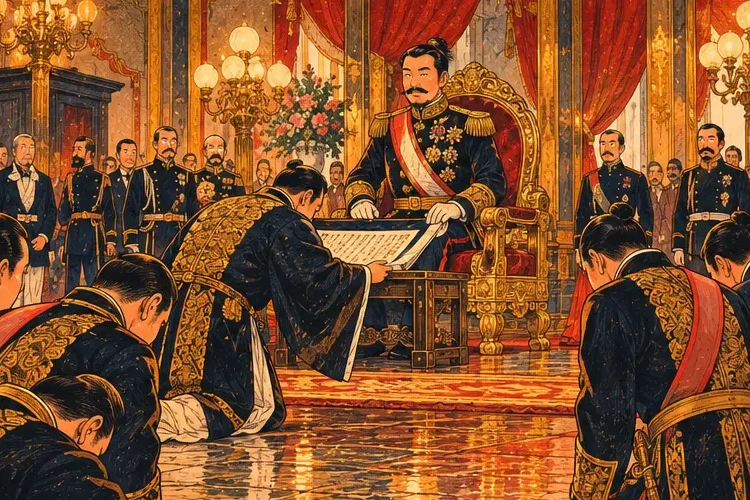
Issued in 1889, it created a two-chamber Imperial Diet (House of Representatives and House of Peers), but the emperor was “sacred and inviolable,” and the army and navy answered to him rather than to the elected government. Only a small share of men could vote at first. The first Diet met in 1890.
First Sino-Japanese War (1894–95)
Japan and China competed for influence in Korea. Japan’s modern army and navy won decisively. The Treaty of Shimonoseki (1895) gave Japan Taiwan and a large indemnity. European powers then pressured Japan to give back one of its gains, the Liaodong Peninsula, which angered the public.
Russo-Japanese War (1904–05)
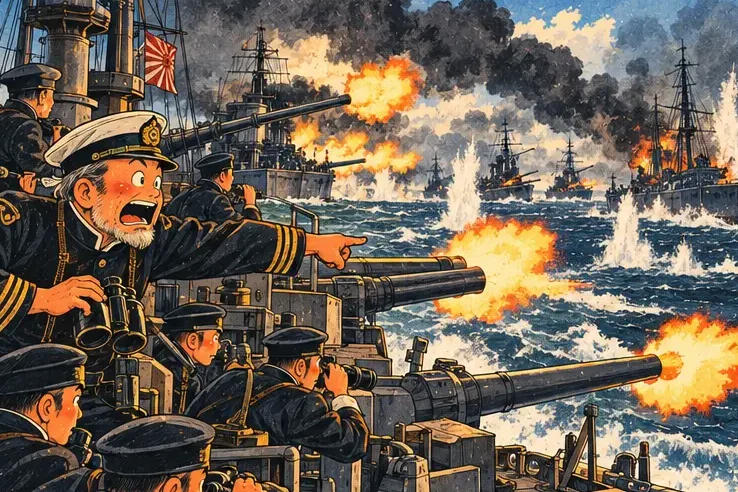
Rivalry over Manchuria and Korea led to war with Russia. Japan won major land battles and, in May 1905, destroyed Russia’s Baltic Fleet at Tsushima. The US President Theodore Roosevelt mediated the Treaty of Portsmouth. For the first time, an Asian country had defeated a European great power, and the news was received with admiration across Asia, and some worry in Europe.
The costs
Japan annexed Korea in 1910, ruling it until 1945. The colonial period involved forced assimilation and left deep bitterness. By 1911 Japan had finally won back control of its tariffs and ended the unequal treaties.
See it today
- Shunpanrō (Shimonoseki): the inn where the Treaty of Shimonoseki was signed, with a small museum.
- Memorial Ship Mikasa (Yokosuka): Admiral Tōgō’s flagship at Tsushima, preserved as a museum.
- National Diet Building (Tokyo): free English-language tours are available. Check conditions before visiting.
Festival connection
Find events near Shimonoseki and Yokosuka on Japan Festival Atlas.