Bakumatsu: Black Ships, Swords and the End of the Shogun
Quick version
- Commodore Perry's 'Black Ships' arrived in 1853, forcing the opening of Japan.
- Unequal treaties and political killings split Japan into factions.
- Satsuma and Chōshū, once rivals, allied in 1866, with help from Sakamoto Ryōma.
- The Boshin War (1868–69) ended with the loss of the shogunate and the last stand at Hakodate.
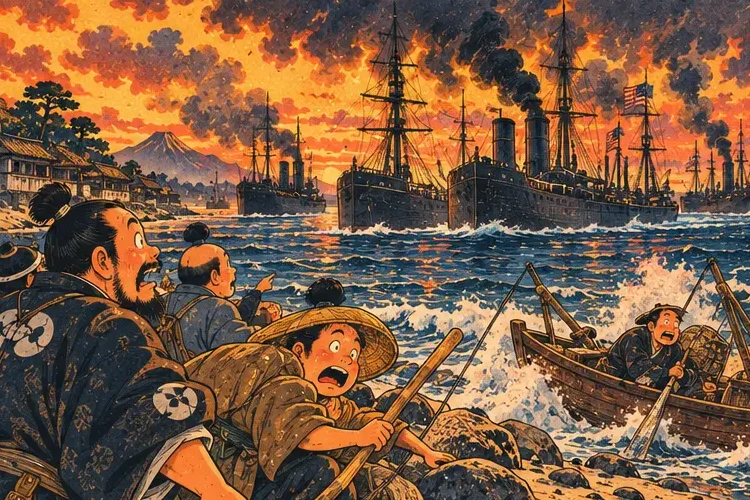
For over 200 years, the shogunate had controlled foreign contact. Then in July 1853, four American warships under Commodore Matthew Perry sailed into Edo Bay. They were steam-powered and black-hulled, soon nicknamed the Black Ships (kurofune). Perry carried a letter from the US President demanding that Japan open its ports.
The doors open
In 1854 the Treaty of Kanagawa opened ports to American ships. In 1858 further treaties (the Harris Treaty and others) opened trade and gave foreigners special legal rights. Many Japanese saw these as unequal treaties, and they became a symbol of weakness.
Chaos
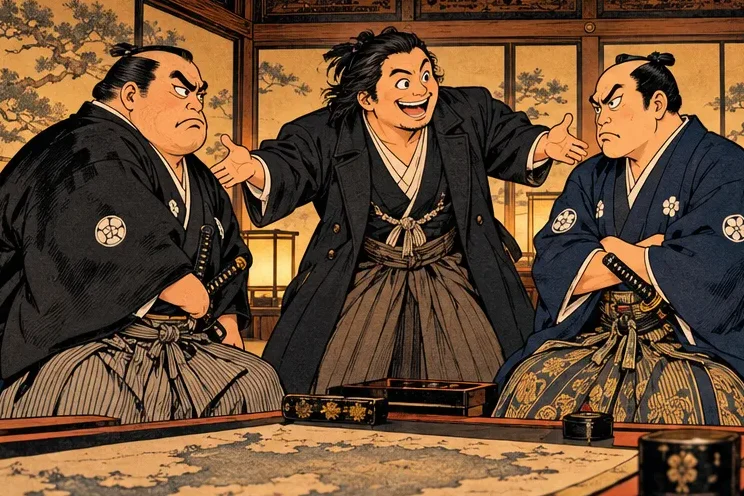
Samurai in several domains rallied behind the slogan sonnō jōi, “revere the emperor, expel the barbarians”. The shogun’s chief minister Ii Naosuke crushed critics, then was assassinated outside Edo Castle in 1860. Kyoto became a battleground. The Shinsengumi, a swordsman unit loyal to the shogun, patrolled the city.
Unlikely allies
The domains of Satsuma and Chōshū were bitter rivals. In 1866, Sakamoto Ryōma of Tosa helped broker an alliance between them. In late 1867 the last shogun, Tokugawa Yoshinobu, returned political power to the emperor, hoping to keep a major role. It did not work.
The Boshin War
Fighting began in January 1868 at Toba-Fushimi. Imperial forces advanced on Edo, which was handed over without a fight after talks between Saigō Takamori and Katsu Kaishū. Some domains resisted, notably Aizu, where young warriors of the Byakkotai became famous for their tragic fate. The last stand took place at the star-shaped fort of Goryōkaku in Hakodate, ending in 1869.
See it today
- Perry Memorial Museum and Kurihama (Yokosuka): where Perry first landed.
- Kyoto: sites linked to the Shinsengumi, such as the former Mibu headquarters area.
- Hagi (Yamaguchi) and Kagoshima: the home cities of Chōshū and Satsuma, with their samurai quarters.
- Aizu-Wakamatsu (Fukushima): Tsuruga Castle and Byakkotai sites.
- Goryōkaku (Hakodate, Hokkaidō): a spectacular star-shaped fortress, with a tower for the best view.
- Kōchi: the birthplace of Sakamoto Ryōma, with a giant statue at Katsurahama.
Festival connection
The Jidai Matsuri in Kyoto (22 October) runs backwards in time, starting with the Meiji Restoration and winding back to the Heian period, with around 2,000 people in period costume. Aizu also holds a festival with a samurai procession in September.