Home › Jōmon · c. 14,000 – 300 BCE
The Jōmon Period: Rope Patterns and a Very Long Picnic

Quick version
- Jōmon people were hunter-gatherers who still lived in settled villages.
- Jōmon means 'rope-patterned', after the cord marks pressed into their pots.
- They lived in pit dwellings and left behind shell mounds (kaizuka).
- Clay figurines called dogū were probably used in rituals.
Picture Japan about 14,000 years ago. The last Ice Age is wrapping up, the sea is rising, and the islands are separating from the mainland. The people living here have no rice, no iron and no metal tools at all. What they do have is pottery, and they were making it earlier than almost anyone else on Earth.
Why “rope-patterned”?
The name Jōmon (縄文) means “cord-marked”. Potters pressed twisted rope into wet clay to decorate it. Early pots were pointed at the bottom, perfect for propping up in a fire. Later ones became wide, flat-bottomed and wildly decorated, which tells us someone, somewhere, really cared about their kitchenware.
Hunting, gathering, and… staying put
You might expect hunter-gatherers to wander constantly. The Jōmon people mostly didn’t. Japan’s forests and coasts were so rich (nuts, deer, boar, fish, shellfish) that people settled in villages for long stretches.
- They lived in pit dwellings (tateana jūkyo): floors dug into the ground, with a roof of thatch.
- They tossed their rubbish into piles that became shell mounds (kaizuka). Today archaeologists treat these as treasure.
- The Sannai-Maruyama site in Aomori shows a large village that lasted well over a thousand years.
The mysterious figurines
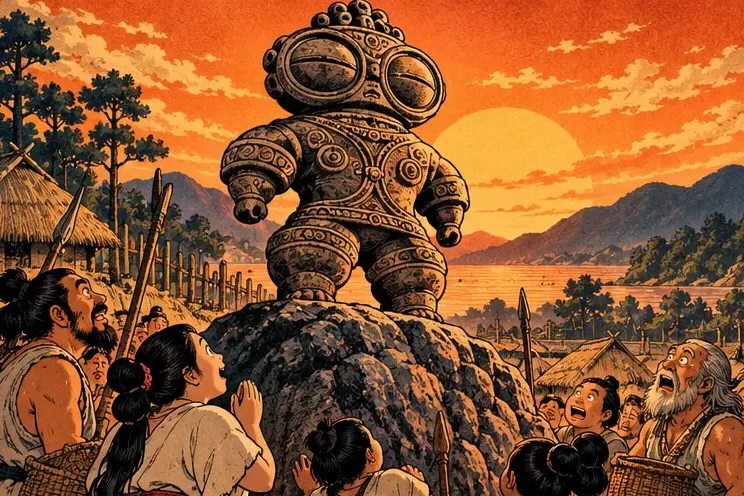
Jōmon people made clay figures called dogū (土偶), many with huge goggle-like eyes. Most are thought to represent women, and they were probably used in rituals for fertility or protection. They were often broken on purpose, which suggests the ritual mattered more than the statue.
See it today
- Sannai-Maruyama Site (Aomori City): a reconstructed Jōmon village with a huge pillar-supported tower, part of a UNESCO World Heritage listing.
- Tokyo National Museum: flame-rimmed Jōmon pots and dogū figurines.
Festival connection
Near Sannai-Maruyama, Aomori City lights up every early August with giant lantern floats at the Aomori Nebuta Matsuri. Hirosaki’s Neputa Festival is a fan-shaped cousin. Neither is Jōmon, but both are fine reasons to be in the area.